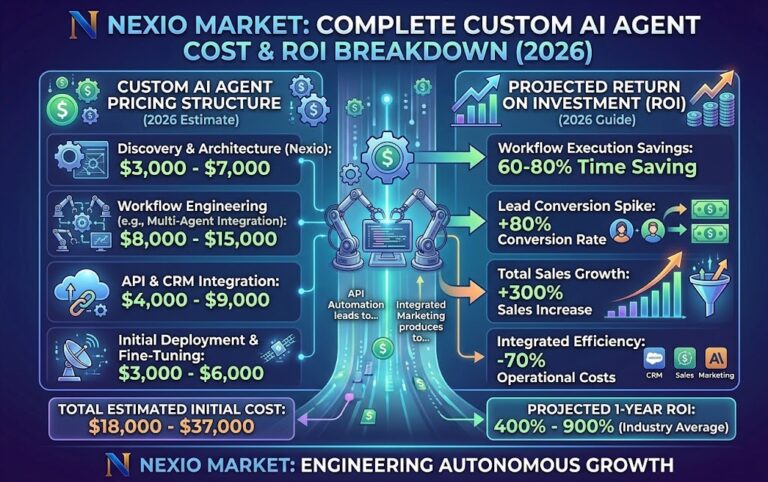
AI agents are moving rapidly from experimental tools to production systems that can automate workflows, interact with business software, process company data, and execute multi-step tasks.
For organizations considering this technology, one question usually comes first: How much does a custom AI agent actually cost to build, integrate, and operate in 2026?
There is no universal price. Unlike standard SaaS products with predictable subscription fees, the cost of a custom AI agent depends on what the system needs to do, which platforms it must connect to, how much autonomy it requires, what data it uses, and the security and reliability standards expected in production.
This guide breaks down realistic custom AI agent development costs, ongoing operational expenses, hidden infrastructure costs, and a practical method for calculating return on investment (ROI).
Custom AI Agent Cost Breakdown at a Glance
Custom AI agent projects generally fall into three broad investment ranges:
| Tier | Typical Investment | Typical Use Cases | Estimated Timeline |
| Basic Task Agent | $5,000–$15,000 | Lead qualification, structured data extraction, simple CRM actions, internal task automation | 2–4 weeks |
| Production Workflow Agent | $15,000–$50,000 | Multi-platform automation, customer support workflows, document processing, invoicing and business operations | 4–8 weeks |
| Enterprise / Multi-Agent System | $50,000–$150,000+ | Multi-agent orchestration, proprietary data environments, complex ERP integrations, advanced governance and enterprise-scale deployment | 8–16+ weeks |
These ranges are planning estimates rather than fixed market prices. Actual costs can vary substantially depending on integrations, security requirements, compliance, data architecture, evaluation standards, infrastructure, and production scale.
4 Key Factors That Determine Custom AI Agent Pricing
Two AI agents may appear similar from the user’s perspective while requiring dramatically different engineering effort behind the scenes. The following factors usually have the greatest impact on development cost:
1. Integration & API Complexity
An agent connected to a single modern application through a well-documented API is relatively straightforward to implement. Complexity increases when the agent needs to communicate with multiple systems such as custom backends, legacy databases, CRM platforms, ERP systems, payment infrastructure, internal APIs, or third-party services. Each additional integration introduces authentication requirements, data transformation, permissions management, failure handling, and security considerations.
2. Degree of Autonomy & Human-in-the-Loop Architecture
An AI agent that only recommends actions requires a different reliability standard from one that can independently send messages, modify records, trigger workflows, or execute business transactions. Higher levels of autonomy typically require additional safeguards such as approval checkpoints, permission boundaries, audit logs, rollback mechanisms, confidence thresholds, and human escalation workflows.
3. Data Pipeline & Retrieval Architecture
Many business AI agents depend on internal company knowledge. When the required information already exists in clean, structured systems, implementation remains efficient. Projects become more complex when agents must process large collections of unstructured documents, fragmented databases, or sensitive enterprise data. Retrieval-augmented generation (RAG), vector search, and data synchronization become significant components of the overall architecture.
4. UI/UX & Platform Integration
Not every AI agent needs a dedicated interface. Some operate entirely behind APIs, while others require custom dashboards, conversational interfaces, administrative controls, mobile experiences, or integration into an existing web platform. A production-ready user interface introduces additional design, frontend development, accessibility, and state management requirements.
Ongoing AI Agent Costs After Launch
Development is only part of the total cost of ownership. Production AI agents also generate ongoing operational expenses:
LLM & API Usage ($100–$1,500+ / month): Actual model costs depend on request volume, context size, token usage, tool calls, and execution frequency. High-volume enterprise systems can exceed this range.
Cloud Hosting & Infrastructure ($50–$500+ / month): Includes application hosting, databases, queues, storage, vector search, monitoring systems, and background workers.
Maintenance, Monitoring & Security ($500–$2,500+ / month): Production AI systems require API compatibility updates, security patches, prompt optimization, model evaluation, and continuous integration upkeep.
Hidden Costs Businesses Should Budget For
The initial development quote does not always represent the complete cost of operating an AI system. Depending on the project, additional expenses may include:
Data preparation and cleaning
Observability and evaluation tooling
Vector databases and retrieval infrastructure
Authentication and role-based access control
Compliance, logging, and security reviews
Backup, recovery, and ongoing QA testing
For that reason, organizations should evaluate Total Cost of Ownership (TCO) rather than comparing AI projects only by their initial development price.
How to Calculate the ROI of a Custom AI Agent
The business case for an AI agent should ultimately be based on measurable value rather than technical novelty. A practical ROI calculation balances Operational Savings (reduction in repetitive manual tasks) and Revenue Impact (faster response times, higher conversion speeds, and improved capacity).
You can calculate first-year financial impact using this standard formula:
For example, suppose an AI agent costs $30,000 to build and operate during its first year. If the organization attributes $75,000 in combined labor savings and additional revenue to the system:
For deeper perspective on choosing the right execution model, read our guide on AI Agent vs AI Assistant in 2026 or explore our insights on Choosing an AI & Web Engineering Partner.
When Is a Custom AI Agent Worth the Investment?
Not every workflow requires a custom AI agent. Custom development makes the strongest business case when a workflow is repetitive, measurable, high-volume, or dependent on multiple business systems. It is particularly valuable when employees perform multi-step digital tasks, information must move between disconnected platforms, or proprietary company data is central to operations.
In simpler situations, standard AI assistants or off-the-shelf software provide better economics. The objective is to identify specific workflows where intelligent automation produces quantifiable operational value.
Build Future-Ready AI Systems with Nexio Market
Successful AI implementation starts with the workflow—not the model. At Nexio Market, we design and engineer digital systems around real operational requirements, connecting AI capabilities with the infrastructure, interfaces, and business processes required for production.
Explore our core technical offerings on Nexio Market Services.
Review selected client implementations in our Portfolio.
Learn about our engineering standards on About Us.
Follow the official Nexio Market LinkedIn Page for technical insights and updates.
Planning a custom AI agent? Contact Nexio Market for a project-specific technical assessment, scope evaluation, and ROI breakdown.