Lorem ipsum dolor sit amet, consectetur adipiscing elit. Ut elit tellus, luctus nec ullamcorper mattis, pulvinar dapibus leo.
In 2026, artificial intelligence is no longer just a trend for tech startups—it is becoming the operational backbone of modern enterprise workflows. However, many business leaders face a practical challenge when evaluating new software architectures: What is the real difference between an AI Assistant and an AI Agent, and which approach delivers higher ROI for your organization?
While basic conversational interfaces and writing assistants dominated early AI adoption, companies are increasingly evaluating autonomous, task-oriented systems. If your goal is optimizing operations and scaling business output, understanding the structural distinctions between an AI Agent vs AI Assistant is essential.
AI Assistant vs. AI Agent: The Core Difference
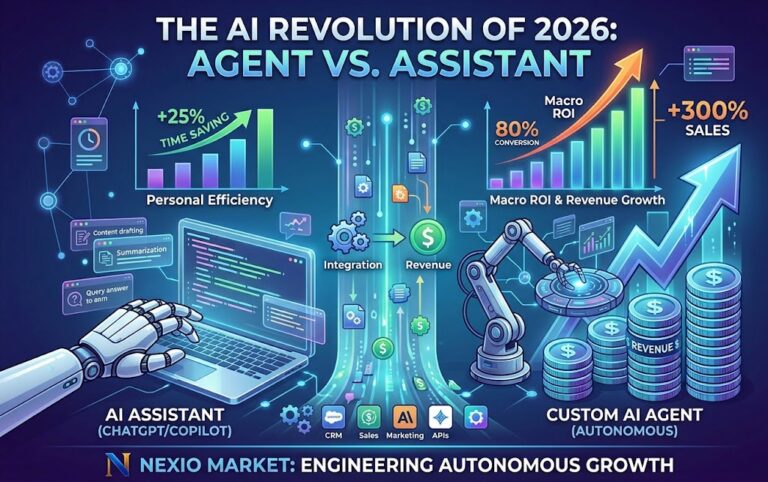
To put it simply: AI Assistants assist humans, while AI Agents execute workflows independently.
AI Assistant: A human-dependent software tool designed to retrieve information, draft content, or generate code snippets based on direct prompts. Examples include standard chatbots, copilots, and standalone research tools that require ongoing human input.
AI Agent: A system engineered to interpret high-level goals, break complex processes into structured steps, connect to external APIs, and execute tasks across integrated software platforms. AI agents can execute multi-step workflows with varying levels of autonomy, often with human approvals for sensitive actions.
If your team is repeatedly writing manual prompts to generate individual outputs, you are using an assistant. If your underlying software architecture automatically processes inbound requests, updates your CRM, and manages multi-step workflows in the background, you are leveraging the power of custom AI agents built by engineering partners like Nexio Market.
Direct Comparison: AI Assistant vs. AI Agent
| Feature / Metric | AI Assistant (e.g., ChatGPT, Copilot) | Custom AI Agent (Enterprise-Grade) |
| Operational Autonomy | Typically requires user prompting | Can execute multi-step workflows with configured autonomy |
| Execution Capability | Generates text, code, or answers | Interacts directly with databases, APIs & apps |
| Business Impact | Enhances individual staff productivity | Streamlines operational processes & workflows |
| System Integration | Standalone interfaces or plugins | Deeply embedded into CRMs, web platforms & backends |
| Oversight Model | Real-time human operation | Human-in-the-loop review for critical actions |
AI Agent vs AI Assistant: Cost, Complexity & Risk
Choosing between an AI Assistant and a Custom AI Agent involves evaluating investment, technical scope, and risk management.
| Factor | AI Assistant | Custom AI Agent |
| Implementation Cost | Lower | Medium–High |
| Integration Complexity | Low | Medium–High |
| Human Oversight | High (Continuous) | Configurable (Event-driven) |
| Business Automation | Limited | High |
| Security Requirements | Standard | Higher (API & Data Permissions) |
| Best For | Individual productivity | Structured, multi-step business workflows |
When You Should NOT Build an AI Agent
While AI agents offer significant technical capabilities, building a custom agent is not always the right first step. You should reconsider or delay building an AI agent if:
Your workflows are undefined: If human processes are inconsistent, automating them will only accelerate errors.
Data quality is poor or unstructured: AI agents rely on clean API connections and structured data inputs to operate accurately.
Transaction volume is low: If a task occurs rarely, a simple manual process or standard AI assistant is far more cost-effective.
Actions carry critical financial or compliance risk without review: High-stakes decisions require robust human approval architecture before full delegation.
4 Ways AI Agents Can Support Revenue Growth
Transitioning from passive tools to structured AI agents allows organizations to modernize core operations. Here is how growing businesses deploy them effectively:
1. Automated Qualification and Client Intake
Rather than relying solely on static contact forms, an integrated AI agent can engage incoming prospects, evaluate technical requirements against business rules, and schedule qualified consultation requests directly into internal calendars.
2. Automated Workflow Execution Across Platforms
Unlike standalone chat interfaces, integrated AI agents perform operations across your tech stack. They can format invoices, log updates in enterprise databases, dispatch notification webhooks, and keep customer records synchronized automatically.
3. Streamlining Repetitive Customer Operations
By automating a significant share of repetitive customer inquiries, businesses reduce operational resolution times while maintaining consistent communication quality across global markets.
4. Context-Aware Recommendations and Internal Insights
By connecting custom AI logic to internal software systems, agents can highlight cross-sell opportunities, analyze account activity trends, and deliver relevant product recommendations to sales teams in real time.
Which Approach Does Your Organization Need Right Now?
Select an AI Assistant if: You need immediate, low-overhead tools to help individual team members write documentation, draft communication, or debug code faster.
Invest in a Custom AI Agent if: You need to automate multi-step business logic, reduce manual data entry across platforms, and scale operational capacity without expanding manual workload proportionally.
Building production-ready AI software requires structured engineering and secure architecture. As detailed in our operational guides on How to Choose the Right Web Development & AI Agency in 2026 and Selecting an AI & Web Engineering Partner, partnering with experienced technical teams ensures your software infrastructure remains maintainable, secure, and performant.
Modernize Your Enterprise Software Stack with Nexio Market
Implementing custom AI architecture requires balancing technical capabilities with practical business requirements. At Nexio Market, we engineer scalable web applications, robust software platforms, and targeted AI agent integrations designed to meet specific enterprise operational goals.
Discover our complete engineering capabilities on the Nexio Market Services page.
Explore selected projects and technical work in our Portfolio.
Learn more about our technical philosophy and standards on our About Us page.
Connect with us on our official Nexio Market LinkedIn Page for technical insights and company updates.
Looking to evaluate custom AI integration for your platform? Contact Nexio Market to speak with our software engineering specialists.