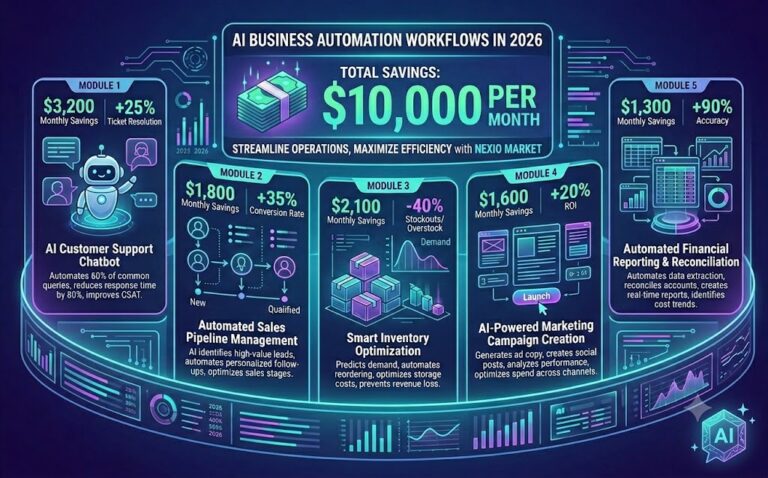
In 2026, implementing AI automation across business workflows reduces operating expenses by up to $10,000 per month by eliminating repetitive manual labor. By automating customer support, data entry, lead qualification, email marketing, and financial reporting, modern enterprises increase operational efficiency while maintaining lean, scalable teams.
The ROI of AI Business Automation in 2026
| Automated Workflow | Traditional Operational Cost | AI-Automated Cost | Estimated Monthly Savings |
| Customer Support Handling | $4,500 / month (3 Agents) | $300 / month (AI Agent) | $4,200 / month |
| Lead Qualification & CRM Entry | $2,500 / month | $150 / month | $2,350 / month |
| Invoice Processing & Accounting | $1,800 / month | $100 / month | $1,700 / month |
| Content & Email Personalization | $2,000 / month | $200 / month | $1,800 / month |
| Total Estimated Savings | $10,800 / month | $750 / month | ~$10,050 / month |
1. Automated Customer Support and AI Agents
Human customer support teams spend hours answering repetitive inquiries regarding order tracking, product specifications, and pricing.
24/7 Availability: Autonomous AI customer service agents resolve over 80% of routine client tickets instantly without human intervention.
Cost Efficiency: Instead of hiring additional support representatives during peak sales cycles, businesses scale their AI infrastructure at a fraction of the cost.
To learn more about custom assistant integration, explore our detailed breakdown on AI Chatbot Development Cost in Europe.
2. Instant Lead Qualification and CRM Integration
Sales teams waste valuable time calling unqualified leads who are not ready to purchase.
Smart Filtering: AI workflows capture website leads, analyze user intent via interactive forms, and score lead quality automatically.
Seamless Syncing: Qualified leads are piped directly into your CRM (HubSpot, Salesforce, or custom databases) with pre-filled buyer profiles, allowing sales reps to focus exclusively on closing deals.
3. Automated Invoicing, Expense Tracking, and Reporting
Manual bookkeeping is prone to human error and delays account reconciliation.
Optical Data Extraction: AI-powered document processors automatically extract line items from supplier invoices, receipts, and PDF contracts.
Automated Reconciliation: Expenses are categorized and posted directly to accounting software without manual data entry.
4. Personalized Email Marketing and Client Onboarding
Generic email blasts yield low open rates and minimal conversion.
Dynamic Personalization: AI automation tools analyze past user browsing behavior on your site to trigger hyper-personalized onboarding sequences.
Higher Conversion Rates: Automated follow-ups deliver tailored offers at the exact moment a buyer displays high purchase intent.
5. Automated Web Operations and Technical SEO Maintenance
Maintaining site performance, fixing broken links, and generating structured metadata manually drains developer resources.
Proactive Monitoring: Modern AI tools run continuous technical audits, optimizing images, updating site schemas, and monitoring Core Web Vitals automatically.
Development Savings: Combining automated site maintenance with modern frameworks drastically lowers backend engineering bills.
For an in-depth cost evaluation, see our guide on How AI Architecture Reduces Web Development Costs by 70%.
Frequently Asked Questions (FAQ)
Will AI automation replace my human staff?
No. AI automation handles repetitive, low-value tasks so your human staff can focus on strategy, high-level client relationships, and business growth.
How long does it take to implement AI business automation?
Most core workflows—such as customer support bots, automated CRM syncing, and email triggers—can be set up and integrated within 1 to 3 weeks.
Is AI automation suitable for small businesses?
Yes. Small businesses benefit the most because AI allows small teams to operate with the output capacity of a large enterprise without scaling overhead costs.