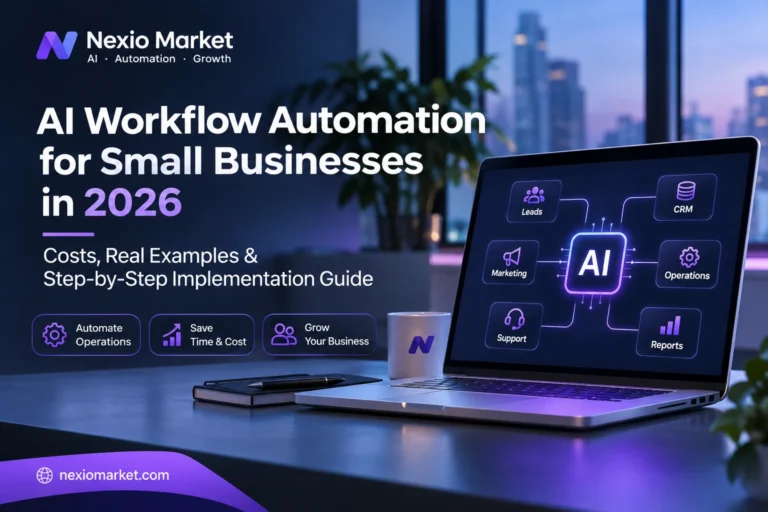
AI workflow automation for small businesses is most useful when it solves a specific operational bottleneck: delayed enquiries, repetitive CRM updates, inconsistent follow-ups, or manual reporting. This guide explains how to choose a workflow, estimate costs responsibly, and launch a measurable pilot in 2026.
What Is AI Workflow Automation for Small Businesses?
AI workflow automation combines triggers, business rules, integrations and—where appropriate—AI models to move information between systems and support repeatable decisions. For example, a new enquiry can be categorized, checked for missing details, routed to a CRM and assigned to a team member. Sensitive decisions should remain subject to human review.
Unlike a standalone chatbot, an automated workflow can connect your website, email, CRM and support tools. It still needs clear ownership, access controls and monitoring. For an overview of common use cases, see our AI business automation guide.
Six Practical AI Workflow Automation Examples
1. Website Enquiry Triage
Collect enquiries through a form, identify the requested service and urgency, flag incomplete submissions, and route each request to the correct inbox. A person approves responses for high-value or unusual requests.
2. CRM Data Entry and Lead Routing
Normalize contact fields, identify likely duplicates and create tasks for sales representatives. Avoid automatically overwriting customer records without review. Read our AI lead qualification and CRM automation guide for a deeper implementation example.
3. Appointment and Follow-Up Coordination
When a prospect selects a meeting time, a workflow can send confirmation, update the CRM and remind the responsible team. Consent, time zones and opt-out preferences must be respected.
4. Customer Support Classification
Classify incoming requests by topic and urgency, suggest answers from approved documentation and escalate uncertain or sensitive cases. Track resolution quality, not only response speed.
5. Document Intake and Review
Extract key fields from invoices or forms, validate them against business rules and send exceptions to an employee. Financial approvals should not rely solely on model-generated output.
6. Weekly Operations Reporting
Combine approved CRM and operations data into a weekly summary, with links to source records. Use deterministic calculations for totals and let AI summarize patterns rather than invent numbers.
How Much Does AI Workflow Automation Cost in 2026?
There is no universal implementation price. Cost depends on workflow complexity, number of systems, data quality, authentication, security requirements, usage volume and ongoing support. Compare vendors using a written scope rather than a generic hourly quote.
| Cost component | What to evaluate |
|---|---|
| Discovery | Process mapping, baseline metrics and integration feasibility |
| Implementation | Triggers, rules, AI steps, connectors, testing and handover |
| Running costs | API usage, automation platform fees, hosting and monitoring |
| Maintenance | Changes to APIs, prompt evaluations, security updates and support |
Ask for a fixed-scope pilot with explicit acceptance criteria. Treat any savings estimate as a hypothesis until measured against your own baseline.
Step-by-Step Implementation Plan
- Choose one measurable bottleneck. Define what happens today, how often and how long it takes.
- Map the workflow. Identify triggers, data fields, owners, approvals and failure paths.
- Check system access. Verify API capabilities, consent requirements, permissions and data retention.
- Build a limited pilot. Start with one team and a reversible integration; retain manual fallback.
- Test edge cases. Include duplicates, missing fields, model errors, unavailable APIs and unexpected input.
- Measure results. Compare processing time, error rate, qualified handoffs and employee review workload.
- Expand only after validation. Document maintenance, escalation and ownership before scaling.
How to Measure ROI Without Inflated Claims
Calculate the change in time spent on the workflow, then subtract implementation and operating costs. For example, measure the average handling time before and after the pilot using comparable cases. Record exceptions and rework as costs. Faster processing is not automatically higher revenue or better customer experience.
Useful KPIs include time to first response, successful CRM handoffs, automation exception rate, manual review minutes and customer satisfaction. Review performance separately for each market and team when operating across the US, UK or UAE.
Common AI Automation Mistakes to Avoid
- Automating a broken process before documenting it.
- Giving AI unrestricted access to customer or financial data.
- Using generic prompts without evaluation or human escalation.
- Launching without logs, error alerts or a rollback plan.
- Claiming savings before collecting baseline data.
- Ignoring GDPR, contractual obligations and applicable local privacy rules.
When Should You Hire an AI Automation Partner?
External implementation support can help when your workflow crosses several tools, needs secure API integrations or must be maintained reliably. Ask prospective partners to demonstrate their discovery process, security boundaries, testing approach and handover documentation. Request a clear distinction between a demo and a deployed production system.
Nexio Market helps teams scope practical automation and integration projects. Explore our services or request a scoped project assessment. Share the process, systems involved and desired outcome; we can then discuss feasibility without promising unsupported results.
Frequently Asked Questions
Can a small business start with one automated workflow?
Yes. A single, measurable workflow is often easier to test, maintain and evaluate than a broad transformation project.
Do I need to replace my existing CRM?
Not necessarily. Many projects begin with integrations around an existing CRM, subject to its API capabilities and permissions.
Is AI required for every automation step?
No. Deterministic rules are usually preferable for calculations, validation and predictable routing. Use AI where interpreting unstructured information adds value.
How long does implementation take?
Timelines depend on scope, integrations, security review and data readiness. A credible estimate requires discovery and agreed acceptance criteria.