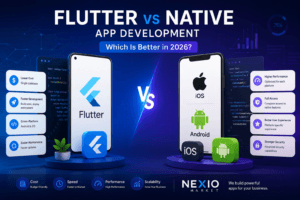
Businesses planning to build a mobile application often face one important question: Should they choose Flutter or Native App Development?
Both approaches have advantages, but the right choice depends on your budget, timeline, business goals, and long-term growth strategy.
In this guide, we compare Flutter vs Native App Development in 2026 and help businesses make the right decision before investing in a mobile application.
What Is Flutter?
Flutter is Google’s cross-platform development framework that allows developers to build Android and iOS applications using a single codebase.
Instead of developing two separate applications, businesses can launch both platforms faster and at a lower cost.
Benefits of Flutter include:
Faster development
Lower development costs
Single codebase
Easier maintenance
Faster updates
Consistent user experience
Flutter has become one of the most popular technologies for startups and growing businesses.
What Is Native App Development?
Native App Development means building separate applications for each platform.
Typically:
Android apps are built using Kotlin or Java
iOS apps are built using Swift
Native development provides direct access to platform-specific features and maximum performance.
Benefits include:
Highest performance
Better hardware integration
Advanced security options
Platform-specific optimization
Superior user experience for complex applications
Native development is often preferred for enterprise applications and performance-critical projects.
Flutter vs Native Development Cost
One of the biggest differences is development cost.
Because Flutter uses a single codebase, businesses often save a significant amount of money compared to building separate Android and iOS applications.
Typical project costs:
Flutter App: Lower Cost
Native Android + iOS: Higher Cost
For startups and small businesses, Flutter is usually the more budget-friendly option.
If you are also evaluating budgets, read our guide on Mobile App Development Cost in Europe in 2026.
Flutter vs Native Development Speed
Development speed can directly affect time-to-market.
Flutter allows developers to:
Build faster
Test faster
Deploy faster
Update both platforms simultaneously
For businesses looking to launch quickly, Flutter offers a clear advantage.
Native development requires maintaining separate codebases, which often increases development time.
Flutter vs Native Performance
Performance is where Native Development still has an advantage.
Native applications communicate directly with operating system components and hardware resources.
Native is often the better choice for:
High-performance gaming
Complex animations
Advanced financial platforms
Resource-intensive applications
However, for most business applications, Flutter performance is more than sufficient.
Most users cannot notice a difference between a well-built Flutter app and a native application.
Which Option Is Best for Startups?
For most startups in 2026, Flutter is the recommended choice.
Reasons include:
Lower cost
Faster launch
Easier maintenance
Faster feature updates
Smaller development team requirements
This allows startups to validate ideas before making larger investments.
Which Option Is Best for Large Businesses?
Large organizations often choose Native Development when they require:
Maximum performance
Advanced security
Complex platform integrations
Long-term enterprise infrastructure
For mission-critical systems, native development can provide greater flexibility and control.
Final Verdict
There is no single solution that works for every business.
Choose Flutter if you want:
Faster development
Lower costs
Cross-platform support
Faster market entry
Choose Native Development if you need:
Maximum performance
Advanced integrations
Enterprise-level scalability
Platform-specific optimization
For most startups and growing companies in 2026, Flutter offers the best balance between cost, speed, and functionality.
Frequently Asked Questions
Is Flutter cheaper than Native Development?
Yes. Flutter usually costs less because developers maintain a single codebase for both Android and iOS.
Is Flutter good for business applications?
Absolutely. Flutter is widely used for business apps, marketplaces, booking platforms, and customer service applications.
Does Native Development perform better?
Yes. Native applications generally provide the highest possible performance and hardware integration.
Which is better for startups?
Flutter is often the best choice for startups due to lower costs and faster development.
Need a Professional Mobile App?
Nexio Market develops Flutter, Android, iOS, AI-powered, and custom business applications for startups and companies across Europe and beyond.
Contact Nexio Market today to discuss your mobile application project and receive a tailored development strategy.